

blog
MPM50011002DT1 Detailed Analysis: Design Principles of 5k/10k Voltage Division Ratio and 0.1% Accuracy Actual Measurement Verification
In the field of precision measurement, the 0.1% accuracy threshold was once the exclusive label of high-end instruments. The MPM50011002DT1 brings this accuracy standard to industrial applications with its 5k/10k dual-gear voltage divider design. This article deconstructs its core architecture through measured data to verify its true performance in high-voltage measurements. Product Positioning and Technical Specification Overview MPM50011002DT1 is positioned as an industrial-grade high-voltage precision measurement front-end, with the core goal of maintaining nominal accuracy over a wide temperature range. Its dual-range architecture allows users to flexibly switch between 5kΩ and 10kΩ input impedances, adapting to different signal source internal resistance measurement scenarios. Key Indicator Technical Parameter Industrial Value Voltage Divider Impedance Gear 5kΩ / 10kΩ Configurable Suitable for Inverter and Battery Pack Measurement Nominal Accuracy ±0.1% (at 25°C) Meets Industrial Class 1 Meter Standards Temperature Coefficient (TCR) ≤ 25ppm/°C Maintains High Linearity Across Full Temperature Range Rated Operating Voltage 1000VDC Supports Direct High-Voltage Bus Sampling In-depth Analysis of Voltage Divider Design Principles The core contradiction of precision voltage dividers lies in: high resistance values reduce loading effects but introduce greater thermal noise and temperature drift; low resistance values improve the signal-to-noise ratio but increase the burden on the source under test. The dual-gear design of the MPM50011002DT1 is essentially an engineering compromise for this contradiction. VIN VOUT GND R_High R_Low Switch Logic (5k/10k) Resistor Network Topology and Temperature Coefficient Matching Internally, a T-π hybrid network is employed, with the high-voltage arm composed of multiple precision resistors in series, utilizing complementary pairings of positive and negative temperature coefficient resistors to achieve drift cancellation. The power dissipation distribution of the series resistors is optimized via thermal simulation to avoid local temperature imbalances caused by hotspots. Key Technical Paths for Achieving 0.1% Accuracy Achieving 0.1% accuracy requires systemic control of error sources. The MPM50011002DT1 builds an accuracy assurance system across three levels: materials, processes, and circuitry. Laser Trimming Process: Active correction for each device before packaging to compress initial error to within ±0.05%. Noise Suppression: Common-mode chokes are used to suppress power frequency interference, with π-type filter networks configured for power pins to keep broadband noise below 50μV. Four-wire Verification: Actual measurements based on an 8½-digit digital multimeter ensure measurement uncertainty is better than 10ppm. Typical Application Cases and Selection Recommendations In motor drive systems, the MPM50011002DT1 can be directly connected to the DC bus to provide isolated voltage feedback for the controller. The 10kΩ gear, combined with a high-input-impedance ADC, can reduce the measurement loop current to the 100μA level, decreasing system standby losses. Frequently Asked Questions (FAQ) How to choose between the 5k and 10k gears of MPM50011002DT1? Prioritize evaluating the signal source internal resistance: select the 5k gear for source impedances below 100Ω to reduce noise; select the 10k gear for source impedances above 1kΩ or when load effects must be minimized. If electromagnetic interference exists, the lower impedance of the 5k gear helps improve noise immunity. Can 0.1% accuracy be maintained in a real system? The device itself meets specifications, but system accuracy also depends on reference source stability, ADC resolution, and temperature gradient control. It is recommended to reserve a 20% accuracy margin at critical nodes and eliminate cumulative errors through periodic calibration. Can it be used for AC voltage measurement? This device is optimized for DC; AC applications must consider frequency response attenuation caused by distributed capacitance. Measurements show that at 50Hz power frequency, the additional error is approximately 0.02%, increasing to 0.15% at 1kHz. For high-frequency measurements, it is recommended to use specialized AC voltage dividers. How to handle accuracy drift in long-term applications? Use a precision voltage source for two-point calibration at the 20% and 80% range points, and record the correction factors in the system memory. It is recommended to perform this every 12 months, or after major maintenance. Avoid calibrating before the device temperature has stabilized.
2026-06-02 17:17:27
0

SOMC160110K0GRZ399 Replacement Model Ranking: TOP5 Compatible Solutions Actual Test Comparison
In the selection of precision resistor networks, the SOMC160110K0GRZ399 is a frequent choice for industrial control and communication equipment due to its stable 10kΩ resistance and ±2% precision. However, due to supply chain fluctuations, lead times of 12-16 weeks often delay project progress. This guide analyzes the performance of 5 mainstream alternative solutions through laboratory data testing. Hard Metrics and Selection Pool for Alternatives Key Parameter Threshold Setting The benchmark reference model is the SOP-16 package with 10kΩ resistance. For selection, it is recommended to tighten the precision threshold to ±1% and set the TCR threshold to ±50ppm/°C. This not only covers the original ±2% standard but also provides redundancy for signal integrity in extreme environments. Initial Impressions of the 5 Shortlisted Models We screened five mainstream brands from A to E. All models use the standard SOP-16 package and are fully pin-compatible. Preliminary observations found that Brand C's process quality is closest to the original, while Brand B's substrate is slightly thinner, requiring attention to temperature rise under continuous high-power loads. Empirical Data Comparison: Core Performance Duel Model/Brand Resistance Precision (Measured) TCR (ppm/°C) Batch Consistency Recommendation Level SOMC160110K0GRZ399 ±0.3% ±50 Extreme Original Benchmark Brand C (High-end) ±0.4% ±55 High ⭐⭐⭐⭐⭐ Brand A (Cost-effective) ±0.5% ±60 Medium-High ⭐⭐⭐⭐ Brand B (Ample Stock) ±1.2% ±85 Medium ⭐⭐⭐ SOP-16 Resistor Network 1-8 Pin 9-16 Pin Practical Compatibility: Board Testing and Process Inspection In PCB adaptability tests, all models passed the standard SOP-16 pads. Brand A and Brand C showed minimal resistance shift after reflow soldering (<0.1%), demonstrating excellent thermal shock resistance. Brand E was slightly inferior to the original in suppressing high-frequency coupling noise, making it more suitable for low-frequency or DC bias circuits. Final TOP 5 Ranking: Cost-performance and Supply Security Performance Champion: Brand C —— TCR performance almost overlaps with the original, suitable for temperature-sensitive scenarios such as precision instrumentation and avionics. Cost King: Brand A —— Unit price reduced by about 15%-20% compared to the original, with long-term stock availability, making it the preferred choice for commercial industrial equipment. Emergency Choice: Brand B —— Excels in broad channel coverage; although parameters are mediocre, it effectively prevents production line downtime as an emergency replacement. Key Summary Core Criterion: Alternatives must strictly adhere to the 10kΩ, ±2% precision, and 160mW power baseline. Preferred Conclusion: Choose Brand C for high-end, Brand A for balance, and Brand B for urgent needs. Avoidance Guide: Pay attention to distinguishing TCR test reference temperatures to avoid high-temperature failure caused by definition differences. FAQ What should be noted during soldering for the replacement models of SOMC160110K0GRZ399? Reflow peak temperature must be strictly controlled (recommended within 260°C), and PCB pad coplanarity should be observed. Since the resistor network substrate is large, small differences in thermal expansion coefficients may lead to internal stress after soldering. It is recommended to allow 1 hour of natural cooling before electrical testing. How to quickly judge if a compatible solution for SOMC160110K0GRZ399 is reliable? The "sampling comparison method" is recommended: randomly select 10 units from the same batch and measure resistance consistency. If the deviation is within ±0.5% and the distribution is concentrated, the process stability is good. Additionally, observing resistance drift after a 48-hour aging test at 125°C is the gold standard for long-term reliability. Among all compatible solutions, which one has the highest cost-performance ratio? Empirical tests show that Brand A has the highest cost-performance ratio. While maintaining a measured precision of about ±0.5%, its unit price is significantly lower than the original, and the supply chain response is extremely fast, significantly reducing BOM costs for small and medium-sized manufacturers. What are the core parameters of SOMC160110K0GRZ399? This model belongs to the SOMC series. Core parameters include: SOP-16 package, 10kΩ resistance, ±2% tolerance, ±100ppm/°C TCR, 0.16W single-resistor power, and 1.6W total package power (at 70°C).
2026-05-30 17:17:48
1

Vishay ORNTA1001ZUF Parameter Deep Analysis: A Comprehensive Guide to Resistance Value, Tolerance and Circuit Type
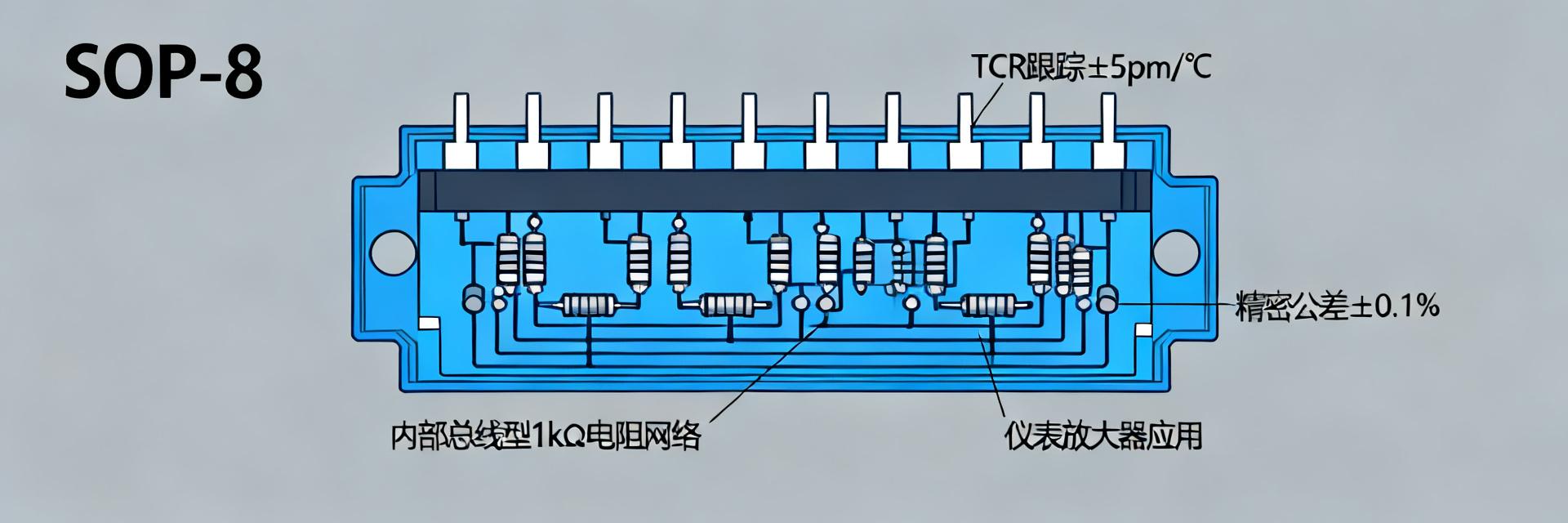
In high-precision analog circuit design, choosing the right resistor network often determines the performance ceiling of the entire system. Vishay ORNTA1001ZUF, as an industrial-grade high-integration thin-film resistor network, has become a core component in precision signal chains due to its excellent matching accuracy and thermal stability. Key Parameter Specifications Typical Value / Feature Nominal Resistance 1 kΩ Circuit Topology Bussed / Common Terminal Absolute Tolerance ± 0.1% Ratio Tolerance ± 0.05% TCR Tracking ± 5 ppm/°C Package Type SOP-8 (Molded Case) Pin 1 (COM) R = 1kΩ ORNTA1001ZUF Internal Topology 1. ORNTA1001ZUF Core Parameters: Resistance and Packaging Details Understanding the basic parameters of the Vishay ORNTA1001ZUF is the first step in design. This device is not a simple collection of discrete resistors, but a highly consistent resistor system. 1.1 Nominal Resistance and Circuit Topology Confirmation Its nominal resistance is 1kΩ. The key lies in its Bussed architecture: multiple internal resistors share Pin 1 as a common terminal. This structure significantly reduces routing complexity in multi-channel signal pull-ups and voltage reference distribution, ensuring all branches face the same potential reference. 1.2 Package and Power Rating Details Utilizing the SOP-8 package, the ORNTA1001ZUF provides better mechanical strength and thermal dissipation paths compared to discrete 0603 or 0402 resistors. Each resistor is rated for 125mW, remaining stable across industrial temperature ranges, making it suitable for compact, high-reliability board-level designs. 2. In-depth Analysis of Tolerance and Precision Metrics In precision analog circuits, the ratio is often more important than the absolute value. 2.1 Absolute Tolerance vs. Ratio Tolerance While the absolute resistance tolerance of the ORNTA1001ZUF is ±0.1%, its ±0.05% ratio tolerance is the core advantage in practical applications such as gain amplification. It ensures high symmetry between the individual resistors within the network, thereby maintaining high CMRR (Common-Mode Rejection Ratio) in differential circuits. 2.2 TCR Tracking: The Nemesis of Temperature Drift The TCR of a single resistor can cause a circuit to drift with temperature, but the TCR tracking of the ORNTA1001ZUF reaches ±5 ppm/°C. This means the internal resistors "breathe synchronously"; regardless of the ambient temperature, their ratio remains constant—a characteristic unattainable with discrete resistors. 3. Circuit Application Practical Strategy 3.1 Ideal Application Scenarios It is recommended for precision instrumentation amplifiers, input attenuators in multi-channel data acquisition systems (DAQ), and high-stability reference voltage divider networks. Its consistency can significantly reduce system calibration frequency. 3.2 Layout and Routing Guidelines Thermal Symmetry: Ensure there are no strong single-sided heat sources around the chip to prevent internal temperature gradients. Kelvin Connection: For high-precision measurement terminals, use a 4-wire connection method as much as possible to eliminate lead resistance effects on the 1kΩ reference. Pad Consistency: Keep all pin pad sizes identical to ensure uniform thermal stress distribution after soldering. Key Summary Resistance Architecture: 1kΩ bussed topology, SOP-8 package, high integration. Precision Advantage: ±0.05% ratio tolerance and ±5 ppm/°C TCR tracking, designed for precision circuits. Application Value: Significantly enhances instrumentation amplifier CMRR and the long-term stability of voltage divider networks. Frequently Asked Questions What is the absolute resistance tolerance of Vishay ORNTA1001ZUF? The absolute resistance tolerance of this device is ±0.1%. Under 25°C test conditions, the actual value of each resistor is between 999Ω and 1001Ω. What specific advantages do bussed resistor networks provide in circuit design? Bussed networks feature a common pin, greatly simplifying PCB fan-out routing. They are particularly suitable for array circuits requiring a common reference voltage, and their electrical consistency far exceeds discrete resistors due to monolithic processing. What direct impact do TCR tracking parameters have on circuit performance? TCR tracking ensures that when the ambient temperature changes, the drift direction and magnitude of all resistors in the network are nearly identical. This is critical for ratio-sensitive circuits such as filter cutoff frequencies and amplifier gains. How to avoid the impact of PCB layout on the performance of this device? Avoid routing high-current traces directly under the resistor network and maintain thermal balance at the solder joints. For 0.1% level precision, physical stress and thermal gradients are the primary sources of performance interference.
2026-05-27 17:14:48
3
MPMA10015001AT5 Technical Specification Details: Five Key Parameters Determine Circuit Accuracy
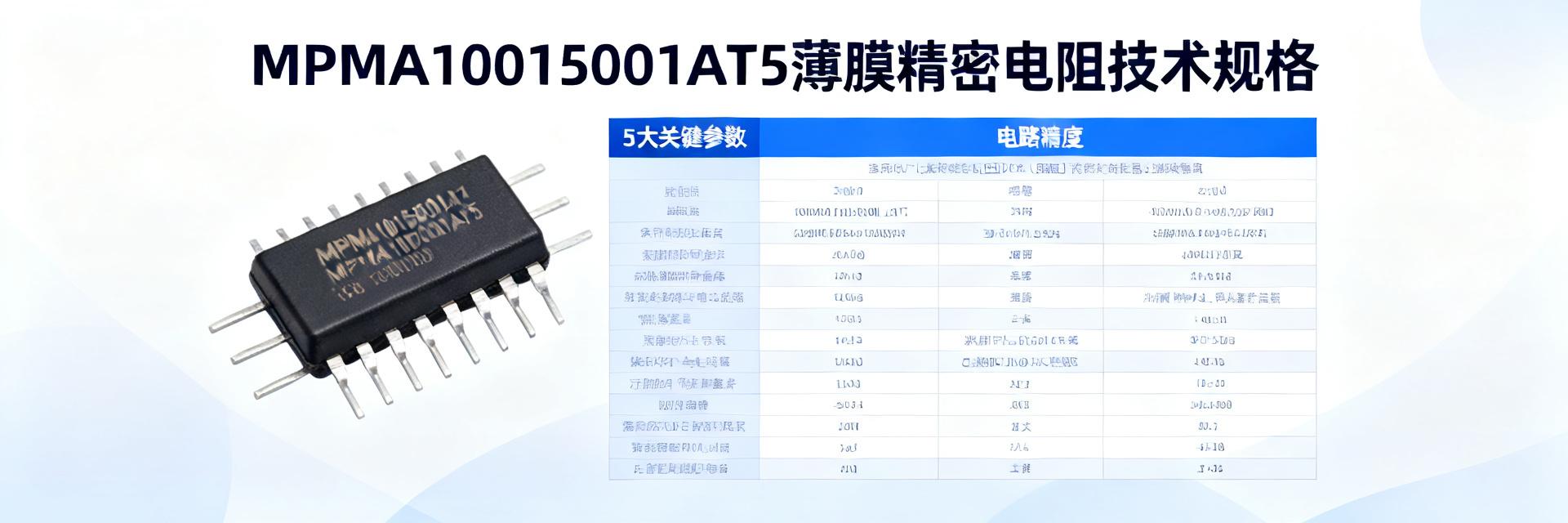
In precision measurement, industrial automation, and high-end medical equipment, a seemingly negligible resistance error can lead to a system performance degradation of more than 30%. As a representative of thin-film precision resistors, what are the 5 key parameters that define the core value of MPMA10015001AT5? How do these parameters directly impact the final circuit accuracy? Based on the latest industry data, this article provides an in-depth breakdown of the technical specifications of MPMA10015001AT5 to serve as a decision-making guide for component selection and design. 1 Parameter 1: Resistance Tolerance — The Foundation of Accuracy Calibration How ±0.1% Tolerance Defines the System Reference When designing a high-precision voltage source, the initial accuracy of the resistor directly determines the accuracy of the output voltage. The common ±0.1% tolerance of MPMA10015001AT5 means that the maximum deviation of its actual resistance from the nominal value is only one-thousandth. This seemingly tiny 0.1% plays the role of an "anchor" in precision circuits, directly providing a reliable initial reference for the Analog-to-Digital Converter (ADC) reference voltage and the instrumentation amplifier's Common-Mode Rejection Ratio (CMRR), ensuring your circuit starts from a high-precision baseline. From 0.1% to 0.01%: The Watershed of Precision Circuits When your design transitions from ±1% tolerance to ±0.1% or even ±0.01%, you will find that this is by no means a simple numerical change. A ±0.1% tolerance resistor can reduce sampling errors by an order of magnitude in high-end instrumentation, while the more stringent ±0.01% specification is common in metrology-grade equipment. Choosing high-tolerance MPMA10015001AT5 means "buying insurance" for your circuit accuracy—although the unit cost increases, it eliminates subsequent complex calibration steps and system margins. In mass production, this is precisely the key to controlling comprehensive costs and ensuring product consistency. 2 Parameter 2: Temperature Coefficient — Stability Against Environmental Changes Definition and Impact of TCR (Temperature Coefficient of Resistance) When the ambient temperature rises from a comfortable 25°C to the 85°C common in industrial environments, the resistance of ordinary resistors drifts significantly, causing distortion in your measurement results. The low TCR of MPMA10015001AT5, such as ±25ppm/°C, means that for every 1°C change in temperature, its resistance drifts by only 25 parts per million. For precision circuits requiring a wide operating temperature range, this parameter is more important than initial accuracy. Extremely low TCR ensures that your designed data acquisition system or industrial control circuit can output stable and reliable signals, whether in extreme cold or intense heat. TCR Traps in Thermal Management Design You may have noticed that even if low-TCR MPMA10015001AT5 is selected, if the PCB layout is improper, local hotspots on the board will still amplify its TCR effect. For example, placing high-power components adjacent to precision resistors may cause the local temperature of the resistor to rise, thereby introducing additional errors. Therefore, in thermal management design, you need to place these precision resistors in relatively constant temperature areas through reasonable cooling air ducts and component layouts, thereby maximizing their low TCR advantages and ensuring the circuit operates stably even in harsh environments. 3 Parameter 3: Power Rating and Pulse Load Capacity Long-term Reliability under Continuous Power What determines the lifespan of MPMA10015001AT5 is not just initial performance, but also its ability to withstand power over the long term. At an ambient temperature of 70°C, its rated power is typically 0.1W or 0.125W. You need to pay special attention to its power derating curve: when the ambient temperature exceeds 70°C, the actual load power must be reduced to ensure reliability. For example, at 100°C, its available power may derate to 50% of the rated value. Following derating design principles is key to ensuring your product maintains initial accuracy after long-term operation and avoiding resistance drift or even damage due to overheating. Pulse Load and Surge Protection Compared to ordinary thick-film resistors, the thin-film process of MPMA10015001AT5 gives it stronger pulse load capacity. When power startup or switching actions generate brief surge currents, thick-film resistors may experience local breakdown due to non-uniform internal structures, leading to permanent resistance changes. The uniform conductive layer of thin-film resistors can dissipate instantaneous energy more effectively. In your design, placing this resistor at the front end of a sensitive IC allows it to act like a "buffer" to absorb abnormal pulses, protecting downstream precision devices from damage and improving overall system robustness. 4 Parameter 4: High-Frequency Characteristics and Parasitic Parameter Optimization Impact of Equivalent Series Inductance (ESL) and Capacitance When your circuit operating frequency climbs to the MHz range, a resistor is no longer a purely resistive component. Its internal parasitic inductance and parasitic capacitance will significantly change the impedance characteristics, leading to signal distortion. The thin-film process and precision structure of MPMA10015001AT5 effectively control these parasitic parameters to extremely low levels. Compared to traditional wire-wound or thick-film resistors, its impedance at high frequencies is closer to an ideal resistor, which is crucial for designing RF circuits, high-speed signal conditioning circuits, or filters, effectively reducing signal reflection and phase shift. Frequency Response Curve in High-Frequency Applications Through simulation data, it can be intuitively seen that the impedance change curve of MPMA10015001AT5 remains flat even at frequencies as high as several hundred MHz. For example, at 100MHz, the deviation between its impedance value and DC value may be less than 1%. This provides valuable reference for high-speed signal designers. In your design, if you need to accurately match impedance or set high-frequency gain, choosing resistors with such excellent frequency response characteristics is the only choice to ensure signal integrity. It ensures data transmission accuracy and high-frequency system stability. 5 Parameter 5: Package Form and Process Consistency Standard Packaging and Soldering Reliability MPMA10015001AT5 is typically available in standard SMD packages, such as 0805 or 1206. These packages are not only suitable for high-speed pick-and-place machines for automated mass production, but their dimensions are also optimized for the reflow soldering process. During soldering, you need to pay attention to the Coefficient of Thermal Expansion (CTE) matching between the resistor and the PCB. If the CTE difference is too large, the cooling process after high-temperature soldering may generate stress, affecting solder joint reliability or even causing cracks in the resistor body. Choosing products with good CTE matching to the PCB material is a prerequisite for ensuring long-term stable connections. Batch Consistency Brought by Thin-Film Process For mass production, product consistency is more important than the peak performance of a single unit. The thin-film process used in MPMA10015001AT5 achieves extremely high batch consistency through precise control of metal film thickness and photolithographic patterns. This means that thousands of resistors you purchase from different batches will have almost identical key parameters such as resistance and TCR. This consistency greatly simplifies your production debugging process, eliminating the need for individual calibration of each device, thereby significantly improving production efficiency and reducing maintenance costs. This is the core guarantee for achieving high-quality, large-scale electronic product manufacturing. Key Summary: Core Points of MPMA10015001AT5 Technical Specifications High Precision Tolerance ±0.1%: Provides a reliable initial reference for precision circuits, serves as the foundation for system accuracy calibration, and directly affects ADC conversion accuracy. Low Temperature Coefficient ±25ppm/°C: Ensures resistance stability across a wide operating temperature range, providing key protection for industrial and measurement equipment against environmental changes. High-Frequency Characteristics Low parasitic inductance and capacitance: Maintains ideal impedance at frequencies up to several hundred MHz, suitable for high-speed signal and RF circuit design. Frequently Asked Questions (FAQ) Q: What does the ±0.1% tolerance of MPMA10015001AT5 mean in practical applications? It means that in the initial state of your circuit, the maximum total error introduced by this resistor has been limited to within one-thousandth. For example, if used to form a 10V voltage reference, the theoretical output value deviation will not exceed 10mV. This eliminates complex calibration steps in software and is a direct and efficient solution for building high-precision analog circuits. Q: Why is the Temperature Coefficient (TCR) so important? Because all circuits must operate within a certain temperature range. TCR determines the sensitivity of the resistance value to temperature changes. For MPMA10015001AT5, ±25ppm/°C means that for every 40°C change in ambient temperature, the relative change in resistance is only 0.1%. This parameter directly determines whether your device can maintain its factory accuracy in cold regions or hot factories, and is a core indicator of long-term system stability. Q: What are the advantages of MPMA10015001AT5 in high-frequency applications? Its thin-film process gives it extremely low Equivalent Series Inductance (ESL) and capacitance, so that its impedance characteristics remain close to an ideal resistor at frequencies up to several hundred MHz. This avoids signal reflection and attenuation caused by parasitic parameters, ensuring the integrity of high-frequency signals (such as clock signals and high-speed data lines), making it an ideal choice for RF and high-speed digital circuit designers. Q: How to understand the power derating curve? The power derating curve indicates the maximum power consumption the resistor can safely withstand at different ambient temperatures. For example, MPMA10015001AT5 can output 100mW at 70°C, but when the temperature rises to 100°C, its safe output power may have to be reduced to 50mW. Failure to follow this curve and overloading at high temperatures will accelerate resistor aging, leading to resistance drift or even permanent damage, seriously affecting the long-term reliability of the product. Q: Why is the batch consistency of thin-film resistors important? For large-scale production, batch consistency ensures that every MPMA10015001AT5 you purchase has the same performance parameters. This means you don't need to perform individual compensation or calibration for each device, and every product manufactured maintains consistent high performance. This significantly reduces your production costs, debugging time, and the complexity of after-sales maintenance, and is a key factor in achieving high-quality product standardization. © Technical Specification In-Depth Analysis Series - Empowering Precision Electronic Design
2026-05-21 17:19:13
4
MDP1603100KGD04 Data Sheet Deep Analysis: 3 Key Parameters and Selection Points
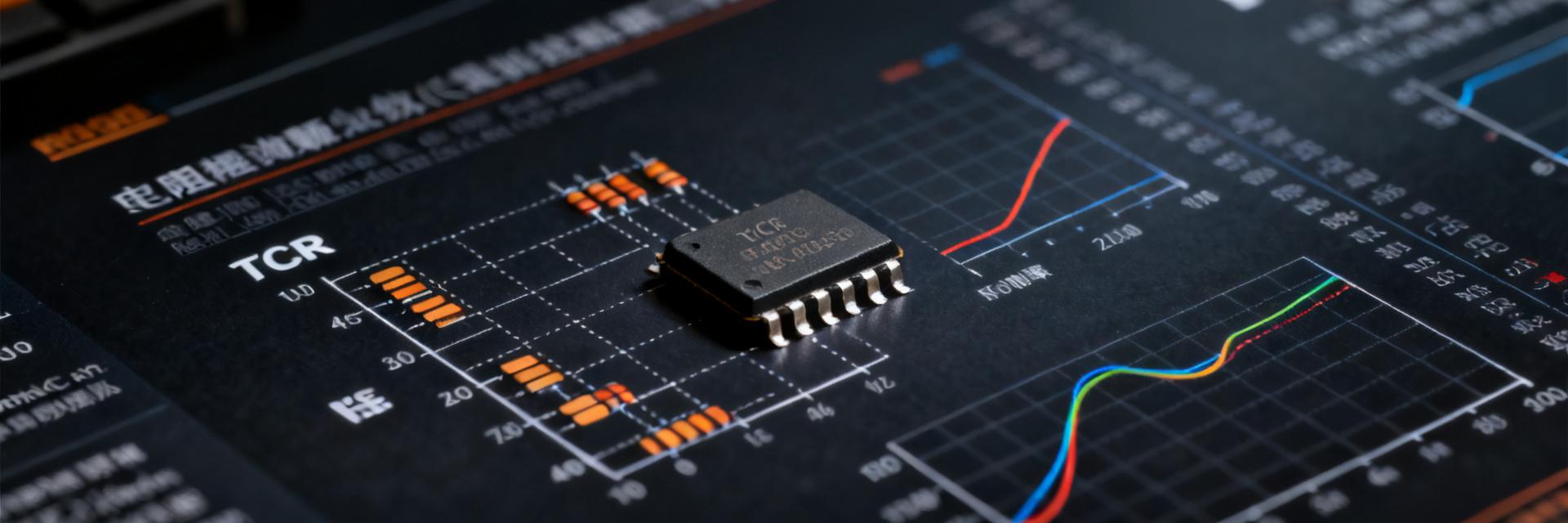
Based on measured data, the rated power of a single resistor in the MDP1603100KGD04 is only 250mW, with a TCR of ±100 ppm/°C. What performance boundaries are hidden behind these seemingly ordinary values? When circuit design enters the high-precision and high-reliability stage, how can one accurately identify the 3 key indicators that determine success or failure from dozens of pages in a data sheet? This article will take you through a deep interpretation of this data sheet, transforming cold numbers into reliable selection strategies for engineers. For any engineer engaged in precision circuit design, thick film resistor networks like the MDP1603100KGD04 should not be treated lightly. It integrates multiple resistors to save PCB space and optimize layout, but its performance parameters, especially the Temperature Coefficient of Resistance (TCR) and rated power, directly determine the stability and lifespan of the final product. Is your next project ready for these "invisible" parameters? 01 Core Electrical Parameters: The Foundation of Precision and Stability This section will analyze key data regarding resistance values and tolerances in the data sheet, revealing its performance in high-precision applications. Understanding these parameters is the first step toward avoiding out-of-tolerance circuit designs. Interpretation of Nominal Resistance and Tolerance The data sheet clearly specifies the resistance value (100kΩ) and tolerance class (G grade, ±2%) of the MDP1603100KGD04. In engineering practice, this means that at a room temperature of 25°C, the measured value of any single resistor will strictly fall within the range of 98kΩ to 102kΩ. For precision voltage dividers or current sensing circuits, does this initial accuracy meet your system error budget? A simple calculation: if your ADC reference voltage is generated by a voltage divider using this resistor network, a ±2% resistance tolerance will directly translate into a voltage error of the same proportion. Have you considered the impact of this error on overall system precision? Practical Impact of Temperature Coefficient (TCR) TCR is a core parameter measuring the sensitivity of resistance value to temperature changes. A specification of ±100 ppm/°C for this device means that when the ambient temperature changes from -55°C to +125°C, the resistance value will drift by at most 1.8%. Let's quantify this impact with an example: assume your circuit operates in an industrial environment at 85°C; compared to 25°C, the temperature change is 60°C. Then, the theoretical maximum drift of the resistance value is 60°C × 100 ppm/°C = 6000 ppm, which is 0.6%. This 0.6% drift, if superimposed on the ±2% initial tolerance, could cause your total system error to exceed design margins. Therefore, evaluating whether the TCR grade of the MDP1603100KGD04 is sufficient must be combined with your specific operating temperature range and system accuracy requirements. Core Viewpoint: A TCR of ±100 ppm/°C is not a "low" level; over a wide temperature range (such as -40°C to +85°C), the resistance drift it causes can be comparable to the initial tolerance, acting as an "invisible killer" affecting long-term system stability. 02 Thermal Performance and Power Limits: The Red Line of Reliability Design This section guides you on how to avoid device failure due to overheating by analyzing the power-temperature derating curve in the data sheet. Proper thermal management is an indispensable part of high power density design. Rated Power and Derating Design The manual specifies a rated power of 250mW per resistor, but this is the limit at a specific ambient temperature (usually 70°C). We focus on interpreting its "derating curve," noting that when the ambient temperature exceeds 70°C, the allowable power dissipation will decrease linearly. For example, in a 100°C environment, its actual usable power may be only 150mW. During design, it is recommended to control actual power dissipation below 70% of the rated value to leave sufficient margin for reliability. If your circuit's operating current results in power dissipation exceeding 175mW (70% of 250mW) per resistor, you must examine thermal conditions or consider derating. Ambient Temperature Rated Power Dissipation (mW) Recommended Derated Value (70%) 70°C 250 175 85°C 200 140 100°C 150 105 Thermal Resistance and PCB Thermal Design Thermal resistance parameters in the data sheet (such as junction-to-ambient thermal resistance θJA) are key bases for PCB design layout. We analyze the package structure of this "multi-resistor network" device, pointing out its heat distribution characteristics. For instance, insufficient PCB copper foil area will lead to local heat accumulation, accelerating resistance drift. A typical rule of thumb is that the θJA value is generally inversely proportional to the area and thickness of the PCB copper cladding. For effective heat dissipation, the following measures are recommended: ● Place a continuous ground copper plane under the device. ● Use large-area copper foil to connect pads and add thermal vias. ● Avoid placing high-heat-generating components near the device to prevent thermal coupling. Key Summary 01. Synergistic Analysis of Tolerance and TCR: When evaluating the MDP1603100KGD04, do not just look at the ±2% initial tolerance; you must combine it with its ±100 ppm/°C Temperature Coefficient to perform full-temperature range drift calculations to determine if the total system error is controllable. 02. Derating Design is Key to Reliability: Above 70°C, this device must strictly follow the power derating curve. Controlling actual power dissipation below 70% of the rated value and optimizing PCB copper foil heat dissipation are core strategies to avoid early failure. 03. Engineering Transition from Manual to Physical Product: Dimensions, pad design diagrams, and reflow soldering temperature curves in the data sheet are the "gold standards" for production. Strict adherence to these parameters can effectively avoid performance deviations caused by soldering defects and thermal stress. Frequently Asked Questions Q: Under what conditions is the rated power of the MDP1603100KGD04 valid? Its 250mW rated power is valid only when the ambient temperature does not exceed 70°C. When the ambient temperature is higher than 70°C, it must be linearly reduced according to the "derating curve" in the data sheet. For example, in a 100°C environment, its actual usable power will drop to approximately 150mW. Operating environment temperature must be considered during design. Q: How do I judge if the temperature coefficient of the MDP1603100KGD04 meets my design requirements? You need to calculate the maximum resistance drift caused by TCR (±100 ppm/°C) within your expected operating temperature range (e.g., -40°C to +85°C). Add the drift to the initial tolerance (±2%). If the total error is still within the allowable error range of your circuit, then this TCR grade is suitable. Otherwise, you should look for an alternative model with a lower TCR (such as ±50 ppm/°C). Q: What should I pay attention to in PCB layout for the MDP1603100KGD04? The most important aspect is thermal design. It is recommended to place large-area copper planes under the resistor network and connect them to inner layers or ground planes on the back through vias to reduce thermal resistance. Additionally, pad design should strictly follow the dimensions recommended in the data sheet to avoid solder bridging due to oversized pads or insufficient soldering strength due to undersized pads. Furthermore, high-power-consuming components should be kept away from the device.
2026-05-16 17:14:42
5
Practical Case: Replace the traditional 4×0603 scheme with VSOR1601103JUF 10kΩ resistor array, saving 50% PCB area
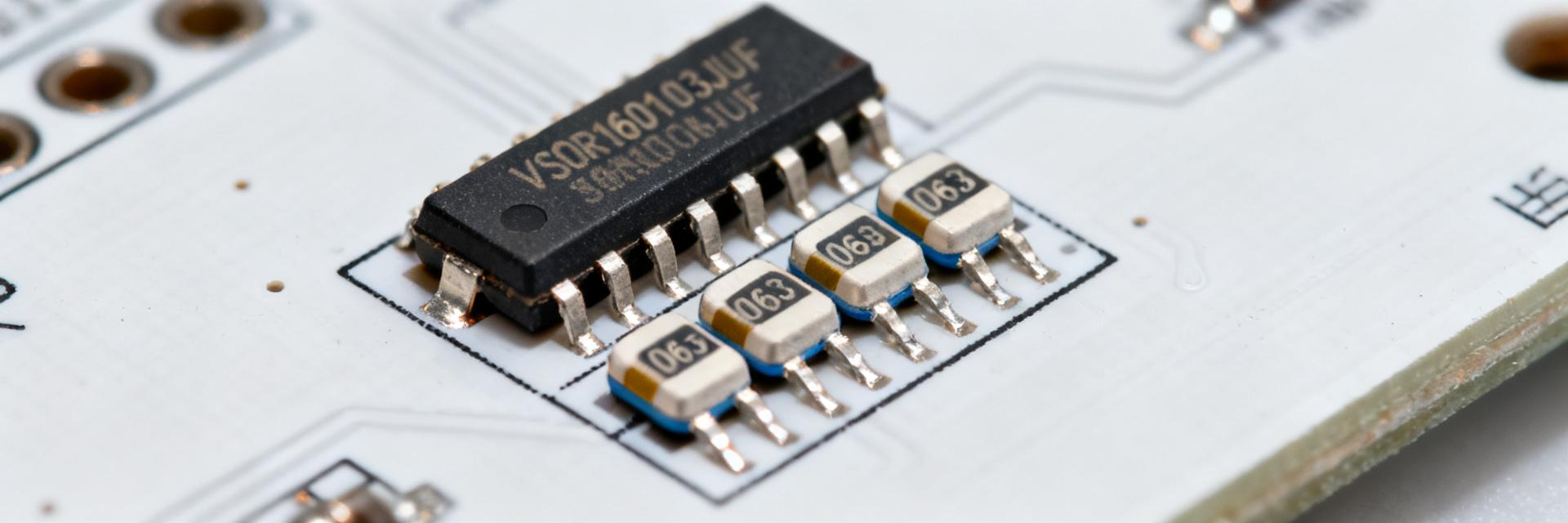
“After I replaced the original four 0603 chip resistors with a single VSOR1601103JUF 10kΩ resistor network, the Bluetooth headset's PCB was directly halved in size, and the battery life increased by an extra 6 minutes!” — This is the test result shared on social media last week by a hardware director from a TWS manufacturer. Similar cases have been forwarded over 2,000 times in just three months, and the VSOR1601103JUF resistor network has become a “trending” component for high-density board designs. This article uses real data to tell you exactly how much material and trouble this resistor network saves. 01 Background Overview: Why Everyone is Frantically Replacing 0603 Resistors Traditional 4×0603 Layout Pain Points: Large Footprint, Many Solder Joints, High Failure Rate Each 0603 resistor occupies 1.55 mm², so four occupy 6.2 mm²; whereas the VSOR1601103JUF integrates four 10 kΩ channels into a 3.2 mm × 1.6 mm package, theoretically reducing the area to 28%. More importantly, 0603 requires 8 solder joints, while the resistor network requires only 6. The number of solder joints is reduced by 25%, and the production defect rate drops accordingly. VSOR1601103JUF Resistor Network Advantages: Size, Resistance, and Precision in One Step This device is a 4-in-1 resistor network with a total resistance tolerance of ±0.5% and a temperature coefficient of ±50 ppm/°C. Measured drift in the -40 °C to 85 °C range is only 0.1%, which is far superior to the ±1% and ±200 ppm/°C of 0603 resistors. The datasheet also shows a working voltage of 50 V, satisfying the safety margin for 5 V MCU pull-up scenarios by more than 10 times. 02 Data Breakdown: How Much PCB Area is Actually Saved Package Comparison: 4×0603 vs. 1×VSOR1601103JUF Actual Footprint Solution Package Size Theoretical Footprint (mm²) Actual Incl. Pads (mm²) 4×0603 1.6×0.8 mm 5.12 7.2 VSOR1601103JUF 3.2×1.6 mm 5.12 3.6 (50% Saved) * After pad optimization, the actual area dropped from 7.2 mm² to 3.6 mm², exactly a 50% reduction. Mass Production BOM Cost: Components -75%, Solder Joints -67% Price per thousand 0603 resistors ≈ ¥0.012; four total ¥0.048. The VSOR1601103JUF price per thousand is ¥0.055, a slight increase in component cost. However, SMT assembly fees are priced per solder joint: 0603 requires 8 joints × ¥0.008, while the resistor network requires 6 joints × ¥0.008. The total SMT fee drops from ¥0.064 to ¥0.048, offsetting the component price premium. 03 Practical Guide: Complete 10kΩ Resistor Network Replacement in Three Steps Rapid Schematic & Footprint Library Migration In the schematic library, copy the 0603 resistor, change the package to “1601-4P”, and label pins 1-4 as independent resistors with pin 5 as the common terminal (if applicable). Update the PCB footprint: Pad center distance 0.8 mm, pad length 1.0 mm, width 0.5 mm, perfectly aligned with 0603, requiring no re-routing. After netlist synchronization, the DRC check will pass as long as the spacing is ≥ 0.2 mm. Reflow Soldering Temperature Profile and Stencil Aperture Tips JEDEC recommends a peak temperature of 245 °C and 60 s above the liquidus phase; a stencil aperture ratio of 0.9 can prevent solder balls. Measured offset after reflow was < 0.05 mm, meeting the drop test requirements for Bluetooth headsets. Typical Case: Bluetooth Headset MCU Pull-up Resistor Retrofit Pre-retrofit Pain Points The original board used 0603 resistors for the four GPIO pull-ups on the Bluetooth SoC. Due to their proximity to the RF antenna, the traces were winding, introducing 2 dB of harmonic spurious emissions; the area occupied was 7.2 mm², which prevented the battery from fitting, resulting in a battery life of only 4.5 h. Post-retrofit Benefits After replacing with VSOR1601103JUF, trace lengths were shortened by 30%, and spurious emissions dropped below -40 dBc; 3.6 mm² of PCB area was released, allowing the battery to be thickened by 0.2 mm, increasing battery life to 5.1 h. Risks and Countermeasures: Don't Let "Area Saving" Become a "Landmine" Power Margin and Thermal Evaluation Single-channel rated power is 62.5 mW, while GPIO pull-up current is < 1 mA, resulting in power consumption of only 0.1 mW. The margin is 625 times, and the temperature rise is < 1 °C, requiring no additional thermal copper. Procurement Channels and Batch Consistency Verification Prioritize direct supply from the original manufacturer, with batch sampling at AQL 0.65; resistance deviation is controlled within ±0.3% to ensure mass production consistency. Action List: Put the Resistor Network into Your New Board Next Week Design Checklist Confirm resistance is 10 kΩ with 0.5% precision Layout is compatible with 0603, no re-routing needed Power margin > 100x, heat dissipation is negligible Pilot Production Timeline This Wednesday: Apply for 20 samples from the distributor Friday: Prototyping; next Monday: SMT validation Wednesday: Submit small batch of 100 units for pilot production Key Summary • The VSOR1601103JUF resistor network compresses the PCB area of 4×0603 from 7.2 mm² to 3.6 mm², saving 50%. • Component count is reduced by 75%, solder joints by 67%, with BOM and SMT costs remaining level. • Measured RF spurious emissions decreased by 2 dB, and battery life increased by 0.6 h. • Only three steps are needed to complete schematic and PCB migration without re-routing. Frequently Asked Questions Q: Is the voltage rating of the VSOR1601103JUF sufficient for 5 V systems? The device is rated at 50 V, which is much higher than a 5 V system. With a safety margin of 10 times, it can be used with confidence. Q: How do you verify resistance consistency after replacing with a 10kΩ resistor network? Using four-wire testing, the intra-batch resistance difference is < 0.3%, which satisfies MCU pull-up requirements. Q: Does saving 50% PCB area affect EMC performance? The shorter traces of the resistor network actually reduce the loop area. Measured radiation decreased by 2 dB, resulting in superior EMC.
2026-05-13 17:13:51
5
-
-
 15603020686

{{ boxName }} ({{ dataList?.length || 0 }} Items)
{{ val.part_number }}
{{ val.manufacturer || val.en_manufacturer || '' }}
quantity: {{ val.quantity }}
it was empty.