


MPMA10015001AT5 Technical Specification Details: Five Key Parameters Determine Circuit Accuracy
In precision measurement, industrial automation, and high-end medical equipment, a seemingly negligible resistance error can lead to a system performance degradation of more than 30%. As a representative of thin-film precision resistors, what are the 5 key parameters that define the core value of MPMA10015001AT5? How do these parameters directly impact the final circuit accuracy? Based on the latest industry data, this article provides an in-depth breakdown of the technical specifications of MPMA10015001AT5 to serve as a decision-making guide for component selection and design.
1 Parameter 1: Resistance Tolerance — The Foundation of Accuracy Calibration
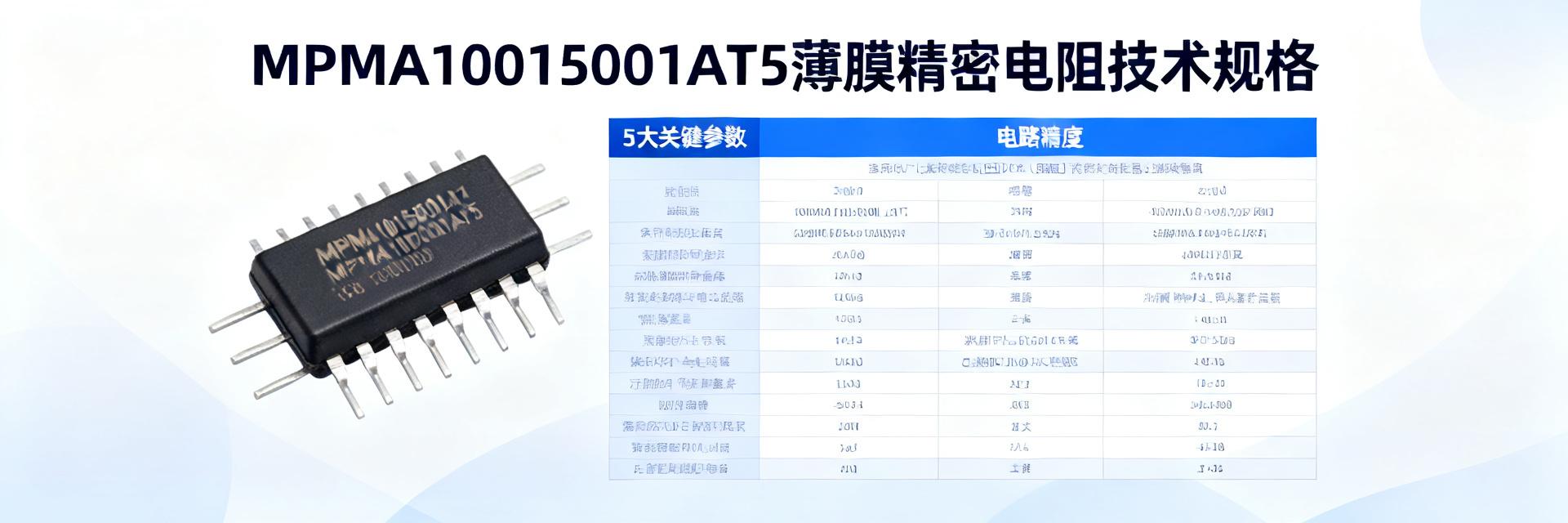
How ±0.1% Tolerance Defines the System Reference
When designing a high-precision voltage source, the initial accuracy of the resistor directly determines the accuracy of the output voltage. The common ±0.1% tolerance of MPMA10015001AT5 means that the maximum deviation of its actual resistance from the nominal value is only one-thousandth. This seemingly tiny 0.1% plays the role of an "anchor" in precision circuits, directly providing a reliable initial reference for the Analog-to-Digital Converter (ADC) reference voltage and the instrumentation amplifier's Common-Mode Rejection Ratio (CMRR), ensuring your circuit starts from a high-precision baseline.
From 0.1% to 0.01%: The Watershed of Precision Circuits
When your design transitions from ±1% tolerance to ±0.1% or even ±0.01%, you will find that this is by no means a simple numerical change. A ±0.1% tolerance resistor can reduce sampling errors by an order of magnitude in high-end instrumentation, while the more stringent ±0.01% specification is common in metrology-grade equipment. Choosing high-tolerance MPMA10015001AT5 means "buying insurance" for your circuit accuracy—although the unit cost increases, it eliminates subsequent complex calibration steps and system margins. In mass production, this is precisely the key to controlling comprehensive costs and ensuring product consistency.
2 Parameter 2: Temperature Coefficient — Stability Against Environmental Changes
Definition and Impact of TCR (Temperature Coefficient of Resistance)
When the ambient temperature rises from a comfortable 25°C to the 85°C common in industrial environments, the resistance of ordinary resistors drifts significantly, causing distortion in your measurement results. The low TCR of MPMA10015001AT5, such as ±25ppm/°C, means that for every 1°C change in temperature, its resistance drifts by only 25 parts per million. For precision circuits requiring a wide operating temperature range, this parameter is more important than initial accuracy. Extremely low TCR ensures that your designed data acquisition system or industrial control circuit can output stable and reliable signals, whether in extreme cold or intense heat.
TCR Traps in Thermal Management Design
You may have noticed that even if low-TCR MPMA10015001AT5 is selected, if the PCB layout is improper, local hotspots on the board will still amplify its TCR effect. For example, placing high-power components adjacent to precision resistors may cause the local temperature of the resistor to rise, thereby introducing additional errors. Therefore, in thermal management design, you need to place these precision resistors in relatively constant temperature areas through reasonable cooling air ducts and component layouts, thereby maximizing their low TCR advantages and ensuring the circuit operates stably even in harsh environments.
3 Parameter 3: Power Rating and Pulse Load Capacity
Long-term Reliability under Continuous Power
What determines the lifespan of MPMA10015001AT5 is not just initial performance, but also its ability to withstand power over the long term. At an ambient temperature of 70°C, its rated power is typically 0.1W or 0.125W. You need to pay special attention to its power derating curve: when the ambient temperature exceeds 70°C, the actual load power must be reduced to ensure reliability. For example, at 100°C, its available power may derate to 50% of the rated value. Following derating design principles is key to ensuring your product maintains initial accuracy after long-term operation and avoiding resistance drift or even damage due to overheating.
Pulse Load and Surge Protection
Compared to ordinary thick-film resistors, the thin-film process of MPMA10015001AT5 gives it stronger pulse load capacity. When power startup or switching actions generate brief surge currents, thick-film resistors may experience local breakdown due to non-uniform internal structures, leading to permanent resistance changes. The uniform conductive layer of thin-film resistors can dissipate instantaneous energy more effectively. In your design, placing this resistor at the front end of a sensitive IC allows it to act like a "buffer" to absorb abnormal pulses, protecting downstream precision devices from damage and improving overall system robustness.
4 Parameter 4: High-Frequency Characteristics and Parasitic Parameter Optimization
Impact of Equivalent Series Inductance (ESL) and Capacitance
When your circuit operating frequency climbs to the MHz range, a resistor is no longer a purely resistive component. Its internal parasitic inductance and parasitic capacitance will significantly change the impedance characteristics, leading to signal distortion. The thin-film process and precision structure of MPMA10015001AT5 effectively control these parasitic parameters to extremely low levels. Compared to traditional wire-wound or thick-film resistors, its impedance at high frequencies is closer to an ideal resistor, which is crucial for designing RF circuits, high-speed signal conditioning circuits, or filters, effectively reducing signal reflection and phase shift.
Frequency Response Curve in High-Frequency Applications
Through simulation data, it can be intuitively seen that the impedance change curve of MPMA10015001AT5 remains flat even at frequencies as high as several hundred MHz. For example, at 100MHz, the deviation between its impedance value and DC value may be less than 1%. This provides valuable reference for high-speed signal designers. In your design, if you need to accurately match impedance or set high-frequency gain, choosing resistors with such excellent frequency response characteristics is the only choice to ensure signal integrity. It ensures data transmission accuracy and high-frequency system stability.
5 Parameter 5: Package Form and Process Consistency
Standard Packaging and Soldering Reliability
MPMA10015001AT5 is typically available in standard SMD packages, such as 0805 or 1206. These packages are not only suitable for high-speed pick-and-place machines for automated mass production, but their dimensions are also optimized for the reflow soldering process. During soldering, you need to pay attention to the Coefficient of Thermal Expansion (CTE) matching between the resistor and the PCB. If the CTE difference is too large, the cooling process after high-temperature soldering may generate stress, affecting solder joint reliability or even causing cracks in the resistor body. Choosing products with good CTE matching to the PCB material is a prerequisite for ensuring long-term stable connections.
Batch Consistency Brought by Thin-Film Process
For mass production, product consistency is more important than the peak performance of a single unit. The thin-film process used in MPMA10015001AT5 achieves extremely high batch consistency through precise control of metal film thickness and photolithographic patterns. This means that thousands of resistors you purchase from different batches will have almost identical key parameters such as resistance and TCR. This consistency greatly simplifies your production debugging process, eliminating the need for individual calibration of each device, thereby significantly improving production efficiency and reducing maintenance costs. This is the core guarantee for achieving high-quality, large-scale electronic product manufacturing.
Frequently Asked Questions (FAQ)
-
-
 15603020686

{{ boxName }} ({{ dataList?.length || 0 }} Items)
{{ val.manufacturer || val.en_manufacturer || '' }}
quantity: {{ val.quantity }}
it was empty.